Freight equipment guide

Heavy-haul shipping for oversized machinery

Need an RGN trailer to haul heavy equipment? Start with the specialized trailers below, then compare open-deck and enclosed equipment. Match a load for the released dimensional screen, or request a heavy-haul quote for FreightMonster to review the shipment.

Equipment selection depends on cargo dimensions, weight, support requirements, availability, and route review. This guide does not issue permits, certify legal movement, assign payload ratings, or guarantee a fit.

30 years in freight

Experience across flatbed, step deck, RGN, and heavy haul lanes.

Open-deck specialists

We match the right trailer, securement, and permits before dispatch.

Responsive updates

You get status, driver info, and quick replies without chasing.

FreightMonster

How to choose equipment and request a quote

FreightMonster is a brand of Streamline LLC. FreightMonster arranges open-deck, enclosed, and heavy-haul transportation with motor carriers. Arranging a shipment does not make Streamline LLC the motor carrier for that load.

FreightMonster arranges equipment transport for shippers across the United States. Open-deck, enclosed, and specialized trailers are starting points. The right equipment depends on cargo dimensions, weight, support requirements, availability, and route review.

Request a quote with the origin ZIP, destination ZIP, ready date, equipment type, length, width, height, and weight. Commodity, piece count, loading method, site limits, and whether permits or escorts may be needed help the review. A quote is an estimate until FreightMonster confirms it.

Published examples include Drill rig heavy haul from Colorado to Wyoming and Flatbed steel load from Indiana to Tennessee. More cleared shipment photos are on the proof page. Authority numbers are on the credentials page.

Use the right level of guidance

Guide, match, then confirm

  1. 1

    Browse identities

    Compare equipment families, explicit class eligibility, and currently reviewed facts.

  2. 2

    Run Trailer Match

    Enter the load dimensions and weight. The shared API returns the current primary, alternatives, and support readout.

  3. 3

    Confirm the move

    FreightMonster confirms equipment, loading, route, permits, securement, carrier availability, and timing.

Heavy-haul shipping for oversized machinery

Specialized / Heavy Haul

Start here for heavy equipment and oversized machinery. An RGN trailer is used when the freight may need the neck removed for ground loading. An extendable RGN is considered for long equipment. A beam trailer is considered when machinery can straddle a narrow chassis.

The right equipment depends on cargo dimensions, weight, support requirements, availability, and route review. Specialized is a guide section, not a fourth Trailer Match requirement, and this page does not assign payload ratings or guarantee a fit.

Open deck · Specialized

Need an RGN trailer to haul heavy equipment?

Removable Gooseneck (RGN)

An RGN is used to haul heavy equipment and machinery that may need drive-on or ground loading. FreightMonster still confirms well support, loading, axle configuration, permits, and the route for the actual shipment.

Reviewed well zoneDetachable neck label
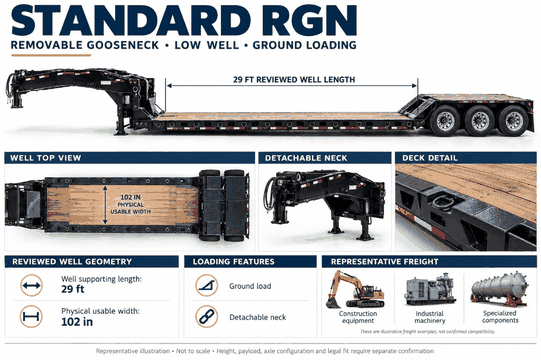
Reference illustration of a standard removable gooseneck trailer with reviewed well and loading callouts.
Illustration. Representative standard removable gooseneck illustration. Raster callouts transcribe reviewed well and loading facts only. Height, axle, and legal-limit claims are omitted. Extendable RGN and jeep or booster setups are distinct. Illustration is not to scale and does not define a specific trailer configuration.

Reviewed guide facts

  • The reviewed support record evaluates load support on the well.
  • Ground-load and detachable-neck capability labels are recorded for the standard RGN identity.

Confirm before booking

  • The guide does not assert payload, axle configuration, permitted weight, route clearance, availability, or mechanical compatibility.
Open deck · Specialized

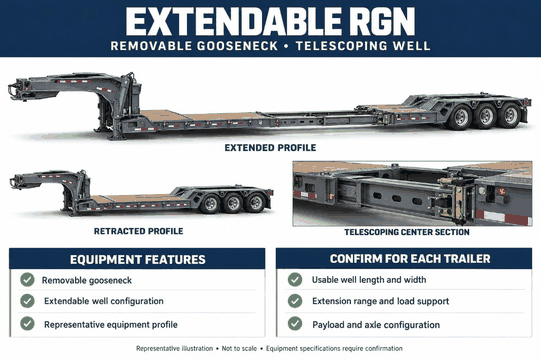
Extendable RGN transport for long equipment

Extendable RGN

An extendable RGN is used when long equipment may need more deck length than a standard RGN. Whether it can carry a shipment depends on the exact trailer, the cargo dimensions and weight, support along the extension, availability, and route review.

Separate RGNE identityGeometry not asserted
Reference illustration of an extendable removable gooseneck trailer with retracted, extended, and telescoping-well views.
Illustration. Representative extendable removable gooseneck illustration. Feature and confirmation labels are illustration text only and do not define extension range, well geometry, cargo capacity, legal limits, axle layout, or a specific trailer configuration. Standard Removable Gooseneck and jeep or booster setups are distinct.

Confirm before booking

  • Extension range, well geometry, support continuity, payload, axle layout, and loading configuration are not asserted.
  • Standard RGN facts must not be transferred to an extendable model by assumption.

Specialized heavy-haul trailer configuration

Beam trailer transport for oversized machinery

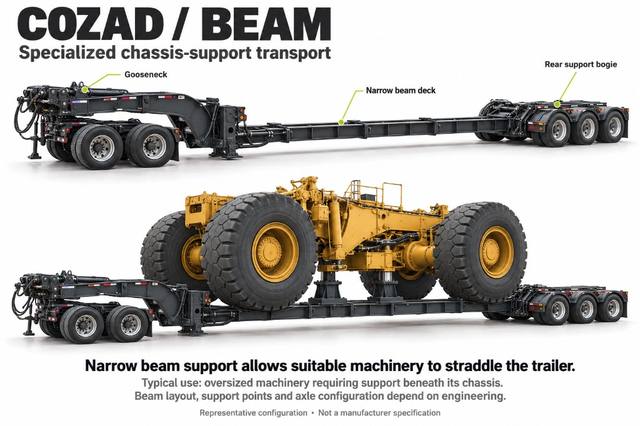
Cozad / Beam

A beam or Cozad-style trailer is used when suitable machinery can straddle narrow supports beneath its chassis. It is a representative configuration for selected oversized equipment, not a support component or an automatic Trailer Match result.

Trailer configurationEngineering required
Reference equipment sheet showing an unloaded and loaded beam trailer configuration that supports machinery beneath its chassis.
Illustration. Representative Cozad / Beam chassis-support configuration. It is a specialized trailer configuration, not a support component, canonical Trailer Match identity, manufacturer specification, or automatic recommendation. Engineering and carrier confirmation are required.

Configuration role

Consider it only when the exact beam layout, support points, cargo dimensions, weight, and axle configuration are engineered for the load.

Confirm before planning

  • This is a representative trailer configuration—not a support component, manufacturer specification, canonical Trailer Match identity, or automatic recommendation.
  • Beam dimensions, cargo support, center of gravity, load placement, axle reactions, ratings, route, permits, and carrier availability require confirmation.

Used with a heavy-haul trailer

Supporting components

A jeep, booster or stinger, and steerable dolly add support or steering to a selected heavy-haul combination. They are not trailers, and cargo weight does not select them automatically.

These components are not Trailer Match identities, are not selected automatically from cargo weight, and do not create standalone equipment matches. FreightMonster must confirm the complete tractor, trailer, component, load-placement, axle, route, and permit plan.

Heavy-haul support component

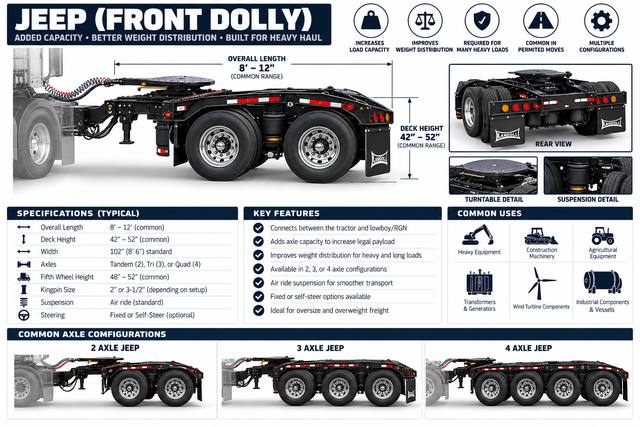
Jeep / Front Dolly

A jeep is used between the tractor and trailer when a heavy-haul combination needs another front axle group. It is support equipment, not a trailer that can be matched on its own.

Between tractor and trailerExact build required
Reference equipment sheet showing a two-axle jeep positioned between a heavy-haul tractor and trailer, with separate configuration views.
Illustration. Representative Jeep / Front Dolly reference sheet. The component is not a standalone trailer or Trailer Match result. Printed dimensions, ratings, axle options, features, and uses require exact-build and complete-configuration confirmation.

Configuration role

Used to change front support and weight distribution as part of a complete engineered configuration—not as a trailer by itself.

Confirm before planning

  • The approved reference sheet is presentation evidence only; its printed dimensions, ratings, axle options, and feature claims require exact-build confirmation.
  • The guide does not certify tractor, fifth-wheel, neck, suspension, tire, axle, permit, or mechanical compatibility.
Heavy-haul support component

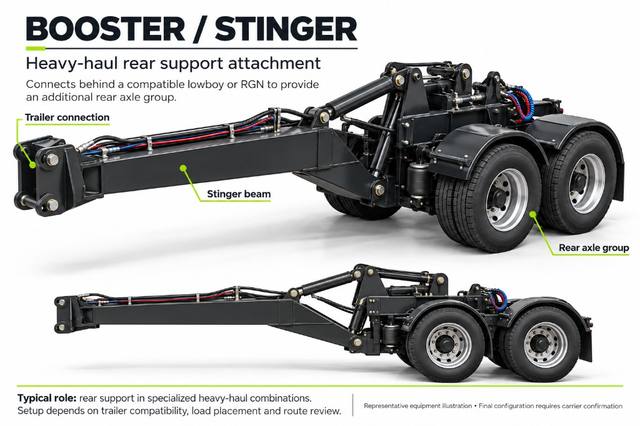
Booster / Stinger

A booster or stinger is used behind a compatible Lowboy or RGN when that combination needs another rear axle group. It remains distinct from a jeep positioned ahead of the trailer.

Rear supportDistinct from jeep
Reference equipment sheet showing a tandem-axle booster or stinger with trailer connection, stinger beam, and rear axle group callouts.
Illustration. Representative Booster / Stinger reference sheet. This rear support component is not a standalone trailer or Trailer Match result. Compatibility, load placement, axle reactions, ratings, route, and permits require complete-configuration confirmation.

Configuration role

Used as a rear support component when the selected trailer and complete configuration are designed for it.

Confirm before planning

  • Compatibility, attachment provisions, axle reactions, ratings, spacing, route, permits, and availability require confirmation.
  • The reference sheet does not establish suitability for a specific trailer, load, or route.

Specialized heavy-haul support component

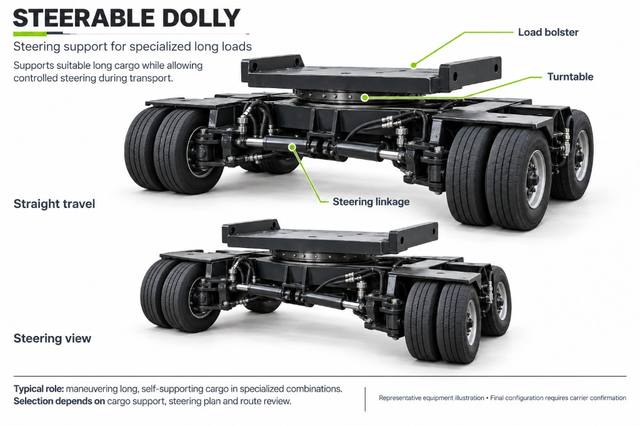
Steerable Dolly

A steerable dolly is used to support suitable long cargo while allowing controlled steering. It is selected for a particular load geometry and maneuvering plan, not by a cargo-weight threshold.

Geometry-specificNo automatic weight threshold
Reference equipment sheet showing a steerable heavy-haul dolly in straight-travel and steering views with load bolster, turntable, and steering linkage callouts.
Illustration. Representative Steerable Dolly reference sheet. This steering and support component is not a standalone trailer or Trailer Match result. Cargo support, connection, turning envelope, route, and permits require complete-configuration confirmation.

Configuration role

Used only within a reviewed heavy-haul configuration; it is not the automatic next step at a particular cargo-weight threshold.

Confirm before planning

  • Steering system, connection, support points, axle reactions, dimensions, route, permits, turning envelope, and availability require confirmation.
  • The reference sheet does not establish suitability for a specific cargo-support or steering plan.

Open deck · Specialized

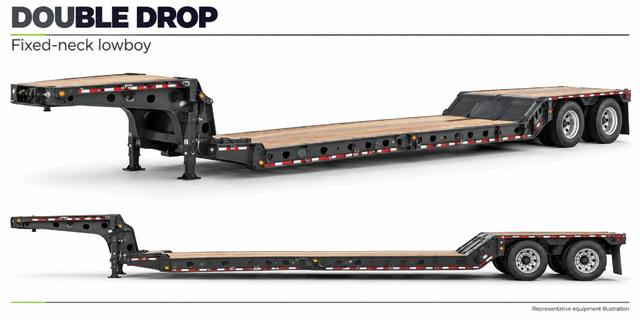
Double Drop, Lowboy & Landoll

These distinct trailers are used for tall equipment that may need a lower deck profile than a flatbed or step deck. The guide does not treat them as one trailer or transfer another identity's facts to them.

Distinct canonical identitiesNo shared geometry claim
Reference equipment sheet showing a fixed-neck Double Drop trailer in three-quarter and side views.
Illustration. Representative Double Drop illustration. The fixed-neck label identifies the depicted presentation only. The illustration does not define reviewed well dimensions, support geometry, payload, axle ratings, legal limits, or a specific trailer configuration. Lowboy, RGN, and Landoll remain distinct identities.

Confirm before booking

  • This guide does not combine these identities or transfer RGN, Step Deck, axle, loading, or support facts between them.

Customer-stated service request

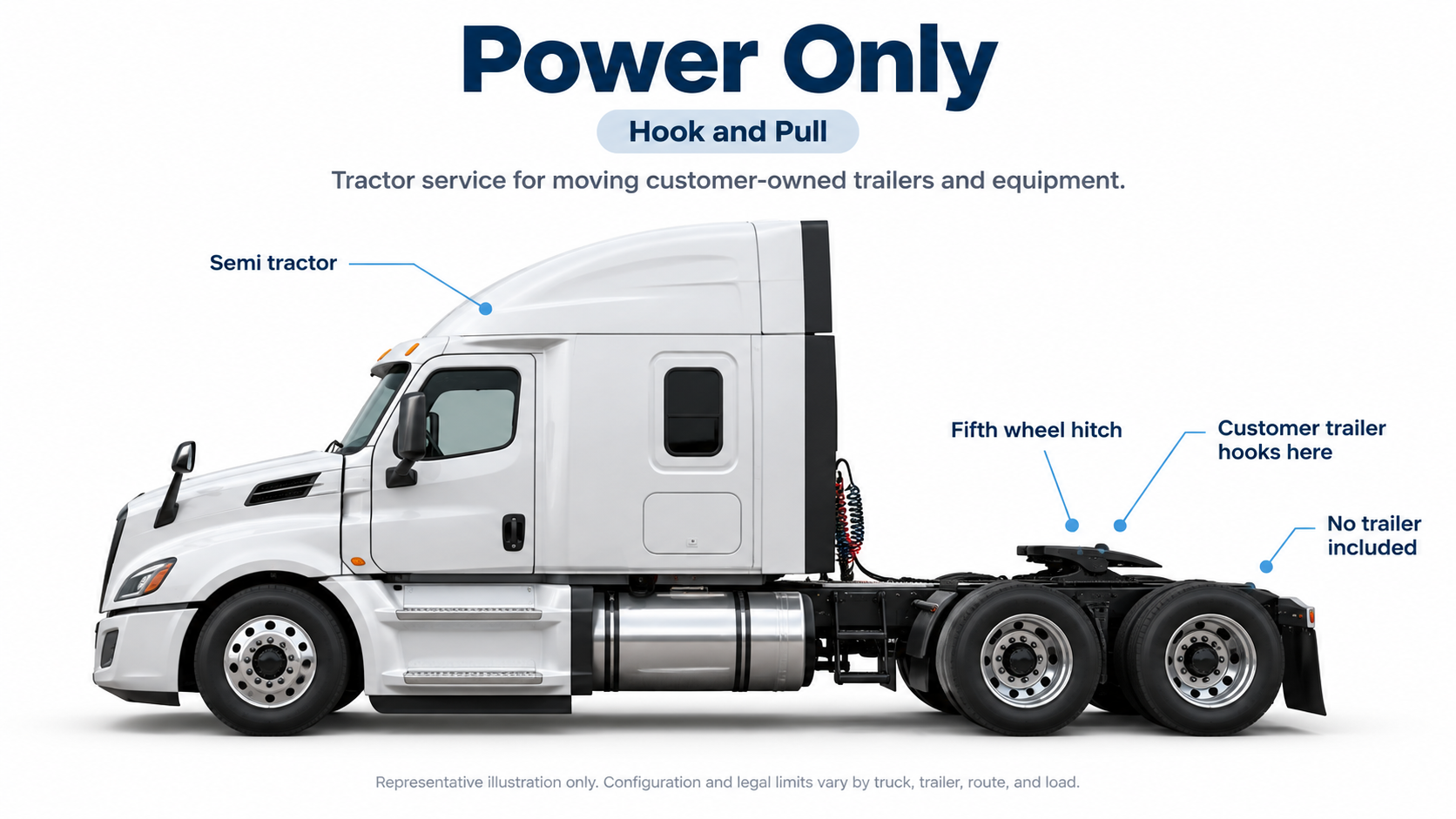
Power Only

Power Only is used when you need a tractor for a trailer or towable unit you provide. It is a service request, not a physical trailer match.

Not a trailer-class matchManual confirmation
Representative illustration of Power Only hook-and-pull service.
Illustration. Representative hook-and-pull service illustration. Customer-stated power-unit class and connection are request details only, not a compatibility determination.

Confirm before booking

  • The request does not determine towing, hitch, braking, axle, weight, permit, route, or carrier-equipment compatibility.

Side, top, and crane-access options

Open deck

Start here when freight can travel without a rigid enclosed body or needs loading access that an enclosed trailer cannot provide.

Open-deck classification does not confirm loading method, securement, tarps, air ride, ramps, availability, permits, or legal movement.

Open deck

Flatbed

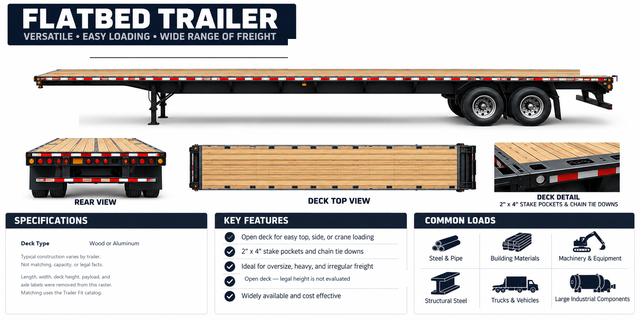
A flatbed is used to haul machinery, steel, building materials, and other freight that can travel with side, rear, top, or crane access.

45 / 48 / 53 ft reviewed recordsSide or rear load labels
Reference illustration of a flatbed trailer with rear, top, and deck-detail views.
Illustration. Representative flatbed trailer illustration. Dimension, payload, axle, and legal-height labels were removed from this raster. Visual approval of the illustration does not make those original labels reviewed equipment facts. They do not define Trailer Fit matching, reviewed capacity, legal limits, or a specific trailer configuration.

Reviewed guide facts

  • Reviewed support records: Flatbed 45 ft, 48 ft, and 53 ft.
  • Side-load and rear-load capability labels are recorded for those reviewed variants.

Confirm before booking

  • Loads above 48 ft need trailer-availability review; above 53 ft may route to Stretch Flatbed when its other criteria qualify.
  • Air ride and sides are separate identities. A dimensional match does not confirm either capability.

Open deck · Long-load review

Stretch / Extendable Flatbed

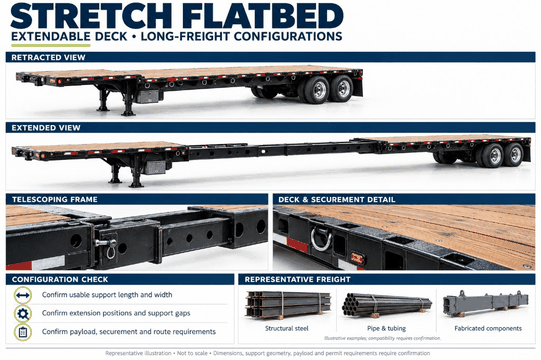
A stretch flatbed is used for long freight that may need more deck length than a standard flatbed, after the released matcher criteria qualify.

Separate FEXT identityExtension facts pending
Reference equipment sheet showing a stretch flatbed trailer retracted and extended.
Illustration. Representative stretch / extendable flatbed trailer illustration. Printed labels are illustration text only and do not define reviewed usable support, extension positions, cargo capacity, legal limits, axle layout, loading support, or a specific trailer configuration. Standard Flatbed is a distinct identity.

Confirm before booking

  • Usable extension positions, continuous support, gaps, overhang, payload, and exact reviewed support geometry are not established in this guide.
  • Trailer availability and route or permit requirements still require review.

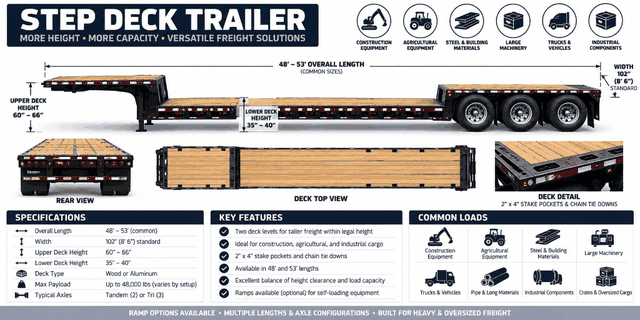
Open deck

Step Deck

A step deck is used for taller equipment that benefits from a lower deck than a standard flatbed.

48-ft lower-deck record53-ft support data pending
Reference illustration of a step deck trailer with rear, top, and deck-detail views.
Illustration. Representative step deck trailer illustration. Typical printed dimension, payload, and axle labels are illustration text only. Visual approval of the illustration does not make those labels reviewed equipment facts. They do not define Trailer Fit matching, reviewed capacity, legal limits, or a specific trailer configuration. Step Deck with loading ramps is a distinct identity.

Reviewed guide facts

  • The 48-ft reviewed variant evaluates support on the lower deck.
  • Loading ramps are recorded only on the separate ramp-equipped identity.

Confirm before booking

  • The 53-ft variant still needs more reviewed support data.
  • A dimensional match does not confirm ramp suitability, loading access, payload, permits, or legal height.

Open deck

Hotshot

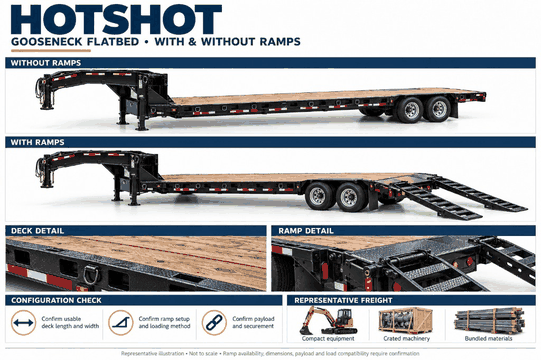
A hotshot trailer is used for smaller machinery and freight that fit the released hotshot screen.

25 / 30 / 35 / 40 ft recordsRamp variants separate
Reference illustration of a hotshot trailer with and without loading ramps, plus deck and ramp detail views.
Illustration. Representative hotshot trailer illustration. Typical printed labels are illustration text only. Visual approval of the illustration does not make those labels reviewed equipment facts. They do not define Trailer Fit matching, reviewed capacity, legal limits, hitch, or a specific trailer configuration. With-and-without-ramps views transcribe reviewed optional ramp loading only.

Reviewed guide facts

  • Reviewed support records exist for 25-ft, 30-ft, 35-ft, and 40-ft variants.
  • Ramp-equipped variants are recorded separately with ground-load and ramp capability labels.

Confirm before booking

  • The guide does not assert payload, hitch, truck class, availability, or that ramps satisfy a particular loading plan.

Rigid and covered trailer identities

Enclosed

Use an Enclosed requirement when the shipment needs the matcher to exclude open-deck-only equipment.

Dimensional eligibility does not certify clear openings, usable interior space, weather protection, security, temperature control, liftgate service, or air ride.

Enclosed

Dry Van

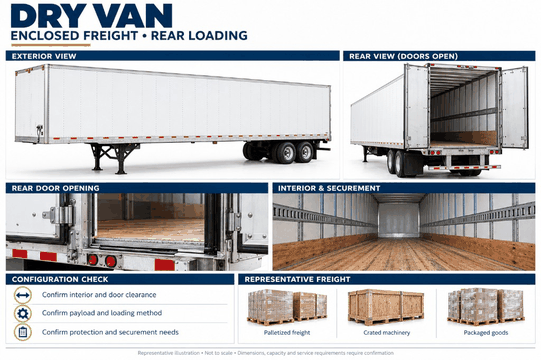
A dry van is used to haul general freight that should travel inside an enclosed trailer.

Neutral enclosed identityAir ride / liftgate require review
Reference equipment sheet showing exterior and interior views of a dry van trailer.
Illustration. Representative dry van trailer illustration. Printed labels are illustration text only and do not define reviewed inside dimensions, cargo capacity, loading access, liftgate, air-ride, legal limits, or a specific trailer configuration.

Confirm before booking

  • The current matcher has one canonical Van envelope; this guide does not invent separate 48-ft or 53-ft usable-interior records.
  • Air ride and liftgate are capability-specific identities and require confirmation.

Enclosed · Capability review

Refrigerated Trailer (Reefer)

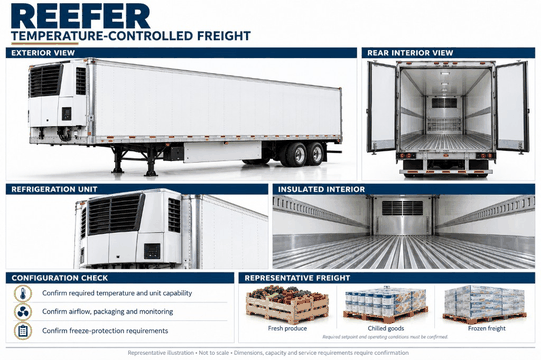
A reefer is used for freight that may need a refrigerated trailer. A dimensional result does not confirm temperature control.

Temperature service unconfirmedEnclosed-only
Reference equipment sheet showing exterior and interior views of a refrigerated trailer.
Illustration. Representative refrigerated trailer illustration. Printed labels are illustration text only and do not confirm requested temperature service, reviewed inside dimensions, cargo capacity, loading access, legal limits, or a specific trailer configuration.

Confirm before booking

  • A dimensional result does not confirm temperature range, pre-cooling, continuous run, food-grade condition, loading access, or availability.

Covered / flexible · Open deck or Enclosed

Curtain Van & Roll-Top Conestoga

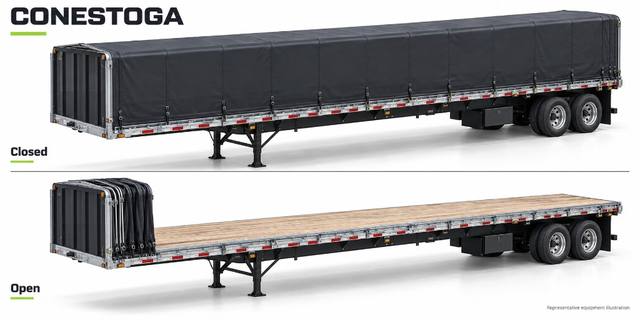
A curtain van or roll-top Conestoga is used for freight that may need covered transport with side or top access. Eligibility does not confirm that access, weather protection, or security.

Dual eligibleShown once under Either
Reference equipment sheet showing a Roll-Top Conestoga trailer closed and open.
Illustration. Representative Roll-Top Conestoga illustration shown closed and open. These views do not certify loading access, usable interior footprint, weather protection, security, support geometry, cargo capacity, or availability. Curtain Van remains a distinct identity.

Confirm before booking

  • Eligibility does not confirm side, rear, top, crane, or drive-on access.
  • Protection, security, usable interior footprint, support across an extension or cover system, availability, and price are not established.

Take the next step

Match, quote, or set up your account.

These links use FreightMonster's existing flows. The equipment guide does not create a second quote form, customer account, carrier approval, or login system.

Practical equipment questions

What trailer do I need to haul heavy machinery?

Heavy machinery often starts with an open-deck trailer. A flatbed or step deck may fit freight that can travel on that deck. An RGN is considered when the machine may need ground loading, and a beam trailer is considered when machinery can straddle a narrow chassis. The choice depends on dimensions, weight, support, availability, and route review.

When should I request an RGN?

Request an RGN when heavy equipment may need the neck removed for ground loading or a lower well. Request an extendable RGN separately when the freight is long. An RGN request does not set payload, axle configuration, permits, or route clearance.

What information is needed for an oversized-load quote?

Send the origin ZIP, destination ZIP, ready date, equipment type, length, width, height, and weight. Add the commodity, piece count, loading method, site limits, and any permit or escort concern when you know them. FreightMonster confirms the shipment before it becomes a booking.

Important limits

Representative configuration guidance is separate from a verified fit or support result. Dimensions, weight, center of gravity, load placement, clear openings, supporting surfaces, axle configuration, permits, route, and actual carrier equipment must be confirmed for the shipment.

Call (877) 419-5523Get a quote